Turning Rejoin
The procedure to break away for a practice turning rejoin is the same as the
straight rejoin. The Wing will call, [Callsign], turning
right/left for rejoin
. The Lead will conduct a clearing lookout, before
approving the rejoin with a thumbs-up or by radio.
- The Wing pulls up and away (~2-3G) from the Lead, applying full power and rolling to approximately 45-50° AOB.
- After turning through approximately 60°, reverse back to 60° AOB towards the Lead (maintaining this AOB) and look for the Lead who should appear in the 10-11 or the 1-2 o'clock low position.
- Commence a descending turn to position the aircraft just behind the rejoin
line. The Wing must start to descend to bring the Lead towards the horizon, then
call
(Callsign of Lead) turn right/left for rejoin
. On the Wing's call, the Lead will turn using 20° AOB and the Wing will join to the echelon position on the inside of the turn in the following fashion. - Maintain full power and continue the descent, positioning the Lead one aircraft length above the horizon on the rejoin line). In the turning rejoin, to maintain a constant position on the rejoin line, you must vary your angle of bank as opposed to the straight rejoin, where heading changes are used to maintain the line. About 200 ft out, set 2600 RPM and as the Lead blooms, reduce power, by feel, to approximately 15", to establish 5-10 kts of overtake and no lateral closure passing through the key position. Move smoothly UP, FORWARD, and IN to the echelon position as per the straight rejoin.
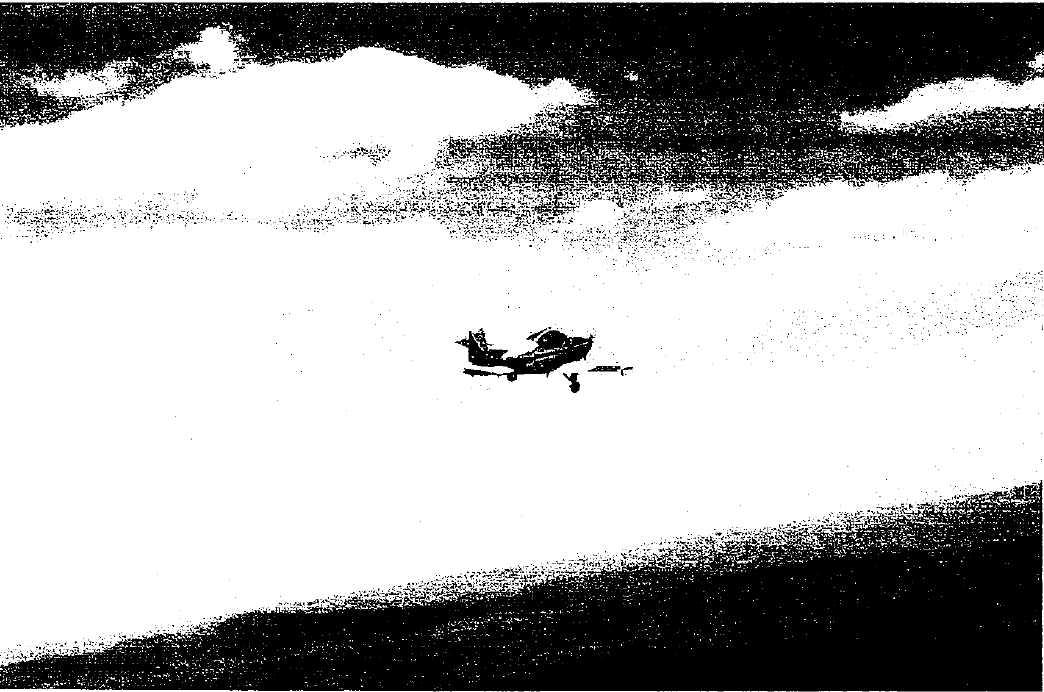
As you close with the Lead, do not make the mistake of descending to pick up the plane of the Lead's wings. This will destroy your attempts to slow down to the Lead's speed and can set up a dangerous situation if you then try to close with the Lead along the plane of the Lead's wings as you have no vertical (reference the Lead) separation with the Lead. It is particularly important in turning rejoins that the horizon is monitored (in the HLS work cycle) to ensure a level rejoin. Staring at the Lead commonly results in the Wing going low.
You must pass through the plane of the Lead's wings to the key position: ie. You should see the underneath of the Lead's aircraft!! If you have misjudged the rejoin, and cannot reduce your closure rate, release the 'g ', level your wings, maintain height separation, and fly through below the Lead, advising "[Callsign], bugging out right/left".
Once established outside the turn, match the Lead's angle of bank to avoid excessive heading divergence. Ensure you stay below Lead's level by keeping the Lead above the horizon. Do not apply too much 'g' when matching Lead's AOB and end up above the Lead. Slide to the inside of the turn (behind and well clear of the Lead), then specify your intentions, eg. "[Callsign], rejoining echelon right/left". The Lead only compounds the Wing's situation if they roll out of their turn or turns towards an overshooting Wing. All rejoins are to be to the inside of the turn!
It is important for a Wing to recognise the potential for excessive closure rates during the turning rejoin. This is because there are two separate components of closure involved. Firstly, the overtake airspeed will cause closure as it did in the straight rejoin. Secondly, the geometric position of the Wing on the inside of the turn will cause significant closure even without overtake airspeed.
Turning rejoins are often used to join up after take-off; it this technique is used, it will always be briefed.