Standard Formation Hand Signals
| Action | Description of Signal | Action to be Taken at: |
|---|---|---|
| Enter the aircraft and strap in. | Thumbs up. | Commencement of signal. |
| Running up. | Hand raised, forefinger extended upwards and revolved in the
horizontal plane.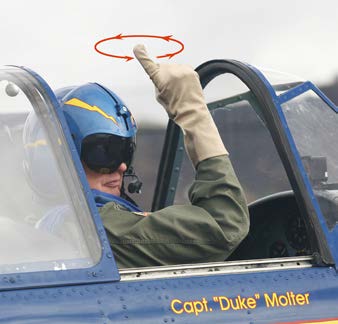 | Commencement of signal. |
| Ready for take-off. | Thumbs up.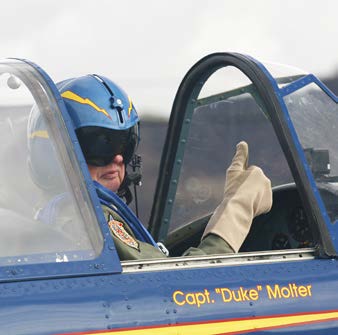 | Commencement of signal. |
| Brakes Release. | Nod of the head.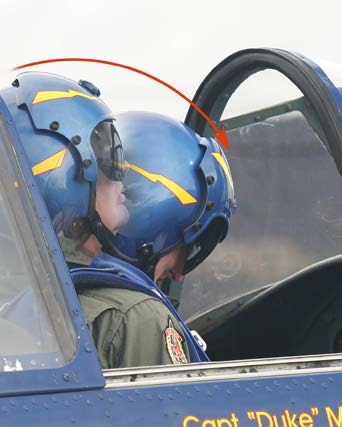 | Chin on chest. |
| Flaps 'up' or 'down'. | Hand horizontal, fingers forward, flapping movement of the thumb in
the vertical plane.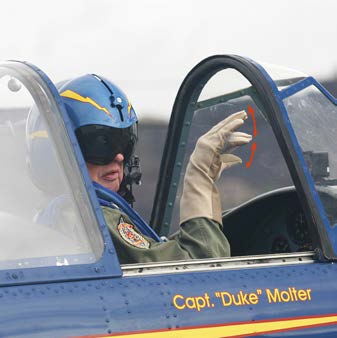 | Nod of the head. |
| Rejoin echelon right. | Rocking of the wings. | Cessation of signal. |
| Relax close formation. | Hand raised, with palm outwards fingers together, palm against the perspex on the appropriate side. | Cessation of signal. |
| Take over as Lead. | Point to the new leader then indicate No 1 position.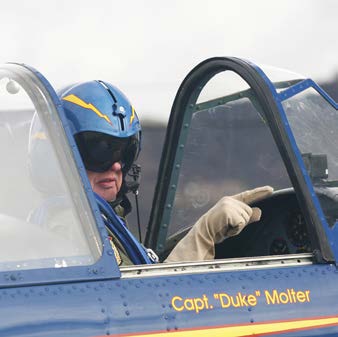 | Cessation of signal. |
| Assuming the lead | Point to chest and raise the hand, forefinger raised to indicate the
No 1 position.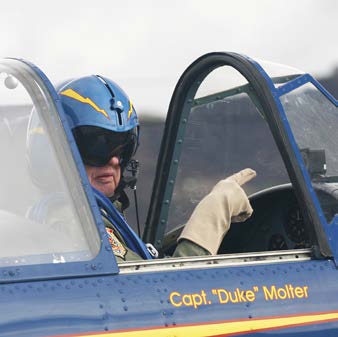 | The change of lead is effected when the pilot relinquishing the lead raises the thumb in acknowledgnient |
| Go echelon right or left. | Point at the aircraft concerned then hand moved across the face to point at the new position. | Cessation of signal. |
| Go line astern | Clenched fist, thumb to the rear of the head. | Cessation of signal |
| Request your fuel state. | Make a drinking motion with closed hand and the thumb extended towards
the mouth.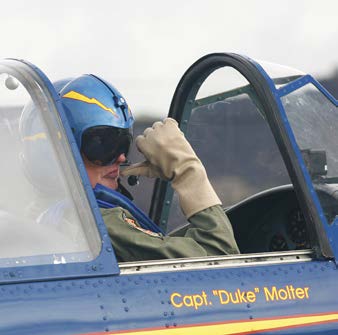 | Cessation of signal |
| Response to the above | See Note | |
| Your aircraft is on fire. | Fly alongside, rock the wings to attract attention, move the edge of the hand across the throat in a cutting motion, then point at the area on fire. Continue this until acknowledged by a thumbs upsignal. | As the situation dictates on completion of the signal. |
| Need to return to land. | Movement of the hand, flat, palm downwards finishing the movement in a simulated round-out. | |
| Require to land in formation. | Pilot requiring to be wing is to pat shoulder nearest to assisting aircraft | |
| Radio Failure | Tap microphone or earphone and give the thumbs up or thumbs down as appropriate. | |
| Systems Failure | Pilot will clench the fist and will hold it to the top of the canopy; after
passing this signal the pilot will hold up the required number of fingers to denote
the system involved (see below). The pilot receiving the signal will repeat it to
show acknowledgment.
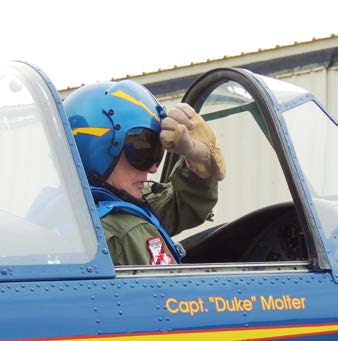
Note: The HEFOE signals are only to be used when radio contact is
not possible. | |
Note:
The procedure for indicating
the remaining fuel state is as follows:
- The amount is to be rounded down to the nearest ten pounds, then only the first two digits are required to be displayed.
- One through to five is indicated by the number of fingers extended vertically.
- Six through to nine is indicated by the number-of fingers extended horizontally.
- Zero is indicated by a clenched fist. (eg. To indicate 260 lbs remaining, the hand is held up with two fingers extended vertically to indicate two, then held up again with one finger extended horizontally).